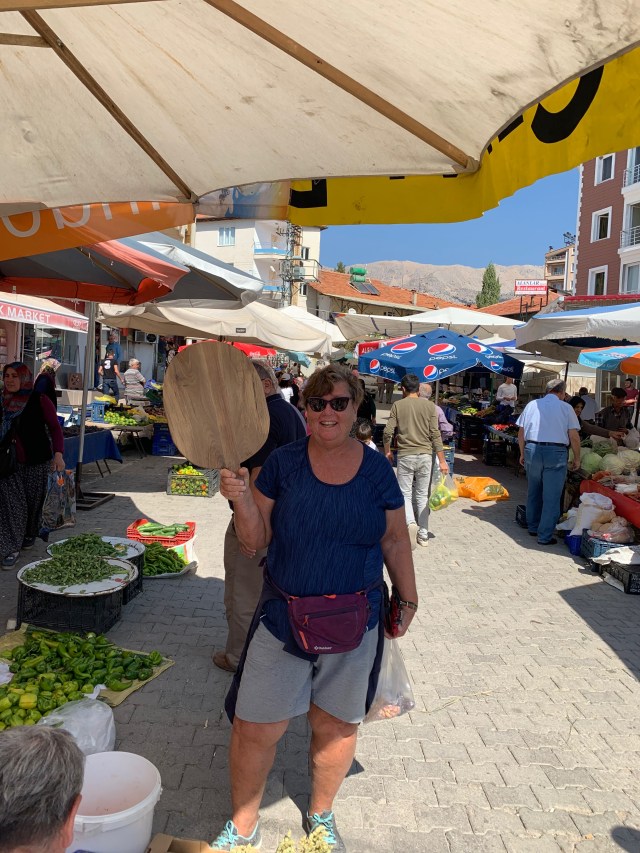
Our purchase of a wooden board on market day
Our purchase of a wooden board on market day
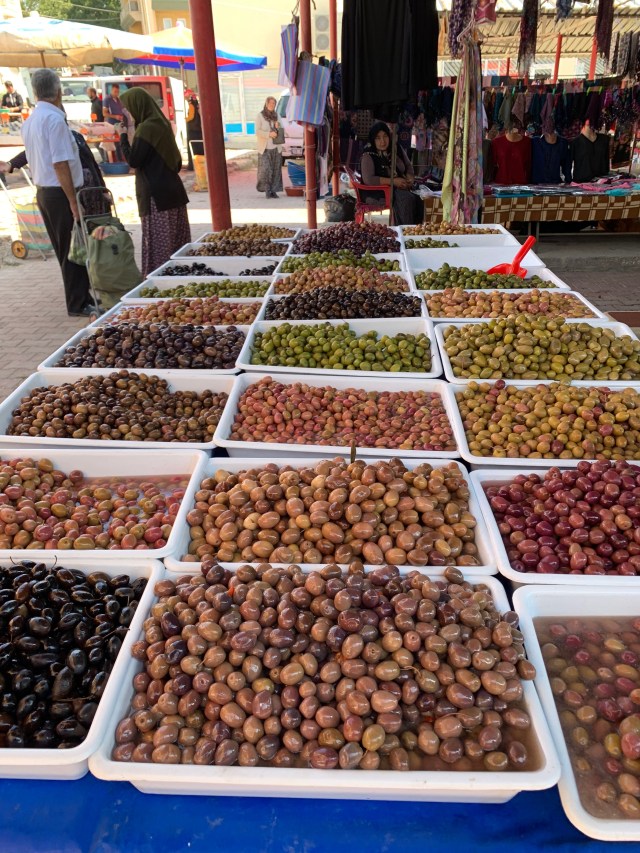
How about some olives?
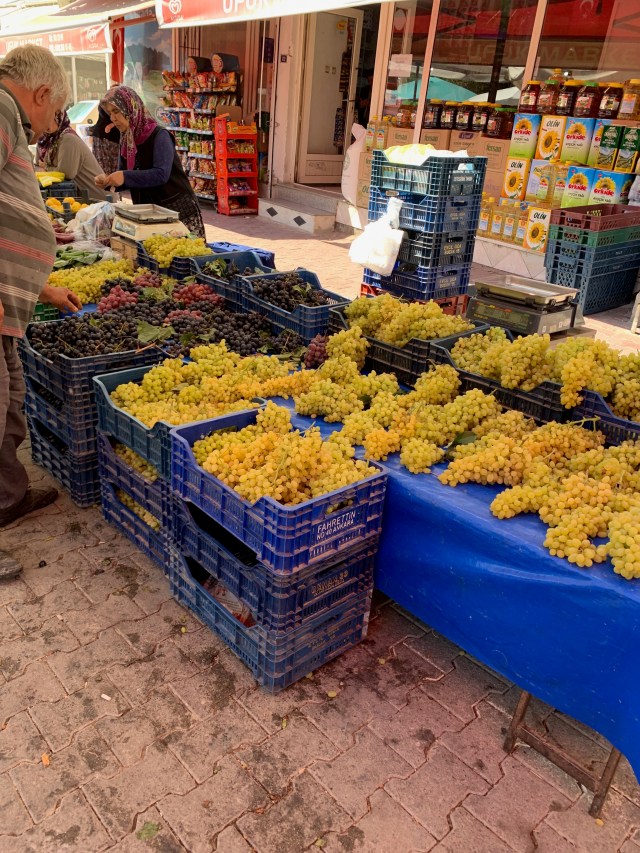
The grape vendor
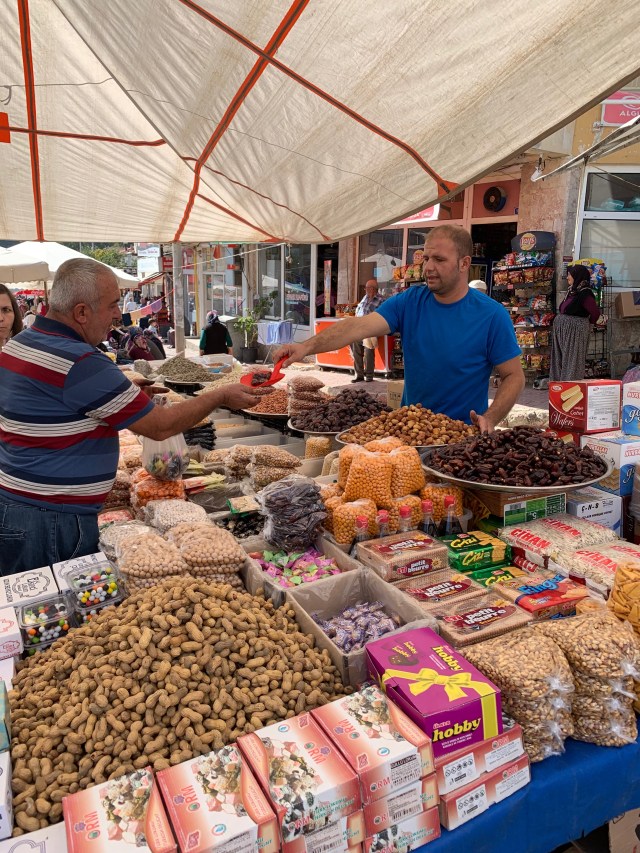
The candy and nuts vendor
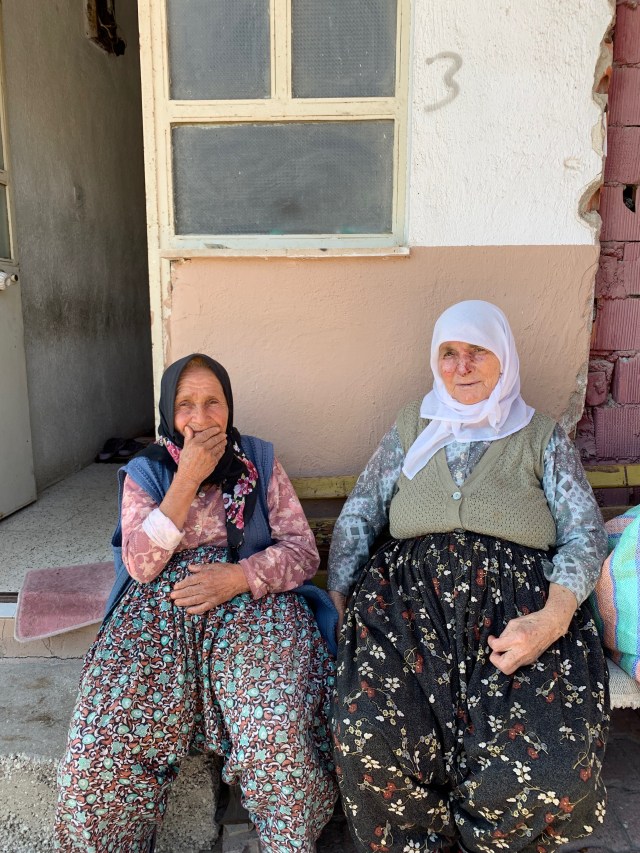
Two friends at Ağlasun
Friday October 4, 2019
ANKARA, Turkey – Arrived in this world capital with a great adventure. Make that, two great adventures.
The joy of planning your own trip is to expect the unexpected. Especially with a car, you can wander about the countryside and make great discoveries. That’s what happened on Friday.
After breakfast at the Hilton Garden, we loaded our treasures back into the car and started off for Sagalassos, an ancient Roman city in southwest Turkey. The site was highly recommended and gave us another moment with antiquity.
On the way to Sagalassos and about seven kilometers from the site, we drove into the small town of Aglasun, pulled into a parking spot and wanted to tap the ATM for money.
TRAVEL NOTE … When obtaining local currency, never, repeat NEVER, use an international exchange center. You can find these everywhere, on the street, in airports and as stand-alone. The commission rate is astronomical and you end up getting less in local currency.
Instead, use the ATM card from your local bank. Before you leave, tell the bank where you will be traveling. With Bank of America, our bank, there is a $5 charge per transaction and a 3 percent fee for the amount of the transaction. In the last few transactions, Waynette, who taps the ATM, has not seen the 3 percent. So, we’ll check with our bank upon our return. By using your ATM card, the savings on fees is substantial and you’re not ripped off by those exchange bandits.
After picking up a few Turkish liras, we started to walk the streets. Because Turkey is about 95 percent Islam, women always cover their heads, wear billowing pants to the ankles and men never wear shorts. With a tee-shirt and shorts on a sunny, 80-degree day, I encountered several strange looks from locals. That clearly made me an outsider and felt a plethora of eyes piercing through my body.
Still, I managed to take a few photos of street scenes and encountered two women sharing a bench. Yes, they allowed me to take their picture.
Quickly, Waynette and I became separated. I began to walk down a street and found that Friday was market day. This is one of Waynette and Lindsay’s favorite travel experiences, and for sure, I knew I could find Waynette among the fruit, vegetable, candy, nuts and olive stalls. I searched everywhere and, alas, nothing.
Then, I started up the street, and she saw me and hurried down.
“Look,” I pointed. “It’s market day. Can’t believe you missed this!”
With that, we disappeared among the stalls and emerged with fruit, figs, nuts, olives, a wooden board and the billowing pants for Waynette.
“What fun,” she exclaimed and this is the kind of experience which make the way we travel so gratifying and rewarding.
Back in the car, we drove up the mountain to Sagalassos. I remarked to Waynette how there were no guardrails on her side of the car!
The city of Sagalassos was developed during Roman Imperial times around the first and second century A. D. The area evolved in the Greek city-state tradition and introduced a democratic constitution, a city council and assembly of the people and citizens who could voice their views and opinions. During development, Sagalassos wanted to show it’s power and importance and began to build monuments in stone found in the mountains.
Only a few structures remain and the area lay in ruins for centuries. That’s when Dr. Marc Waelkens, a Belgium archaeologist who specialized in Turkish archaeology, began to work the site. Waelkens knew of Sagalassos but did not discover its ruins until 1986. The process of excavating the site began in 1991 and continues.
The most impressive structure is The Antonine Nymphaeum, a building that represents the quintessential Roman architecture of the period. There are five statues across the front next to the columns and share space with a cascading waterfall that faces the courtyard. This waterfall is actual water coming from a mountain stream.
Only two statues remain and these are two, larger than life statues of Dionysos. Others were added in the 4th and 5th century A.. D. and represent Nemesis, Apollo, Asklepios and Koronis. Expect for Koronis, all statues were broken and thrown into the courtyard by Christians, and the statue of Nemesis was destroyed in an earthquake between 600 and 620 A. D. The fragmented statues were restored by archaeologists working for the past 30 years.
Equally impressive is the remains of The Theatre, commissioned by the Roman ruler Hadrian in 120 A. D. Hadrian, influenced by Greek culture, history and tradition, wanted Saglaassos to be a cultural center and commissioned several buildings to reflect his desire. One of which was The Theatre. Despite the population of Sagalassos at 5,000, The Theatre was constructed to hold 9,000 people and was the site for theatrical events, public meetings and gladiator encounters. It is believed that 15,000 to 20,000 people lived in the surrounding area.
At first, we thought we’d spend less than one hour on the site, but ended up with nearly four hours of history tucked neatly in our brains.
Around 4 p.m., we started out for Ankara, and according to Siri , this would be about a five-hour drive.
Along the way, we stopped at a roadside cafe, next to a gas station and ordered something for dinner. I’ll show you the picture and defy anyone to tell me what this is or was.
When we pulled in, the lot was filled with water and we encountered only a few drops of rain this entire trip. That was back in Naxos in Greece, and wondered why the lot was wet. Turns out there were guys working this area and washing every vehicle which pulled in, and that included buses.
“Don’t want my car washed,” I said to Waynette and pulled into a spot on the opposite side of the lot. After we ate and returned, the car was wet and we found a guy holding a hose and scrubbing brush beside the car. I flipped a 2t coin, and shook my head. We both laughed for the longest time to see the car wet and thought about the time we stopped at a traffic light in mid-town Manhattan. That’s where the windshield was cleaned and the guy demanded money.
On the road again and about 25 kilometers from Ankara, we encountered a police roadblock and was signaled to pull off to the side.
“This should be interesting,” I said to Waynette as a cop approached.
I rolled down the window and he spoke in Turkish.
Shaking my head, I said, “American.”
With that, he turned, checked the licence plates on the car and saw that it was a rental.
Upon his return, “passports,” he demanded.
Waynette always has these at the ready and after checking both, he waved us ahead. Flipping through the pages, it looked like the cop searched for the entry stamp to make sure we entered Turkey legally.
Back on the road, we arrived at our hotel, a Wyndham, just before 11 and we’re here for two nights. Not sure of the agenda for Saturday, but it likely includes laundry and chilling out.
PICTURES – market day in Aglasun, the Roman city of Sagalassos, and our “dinner” from the road
STEPS – walked 11,813 steps or 5.3 miles
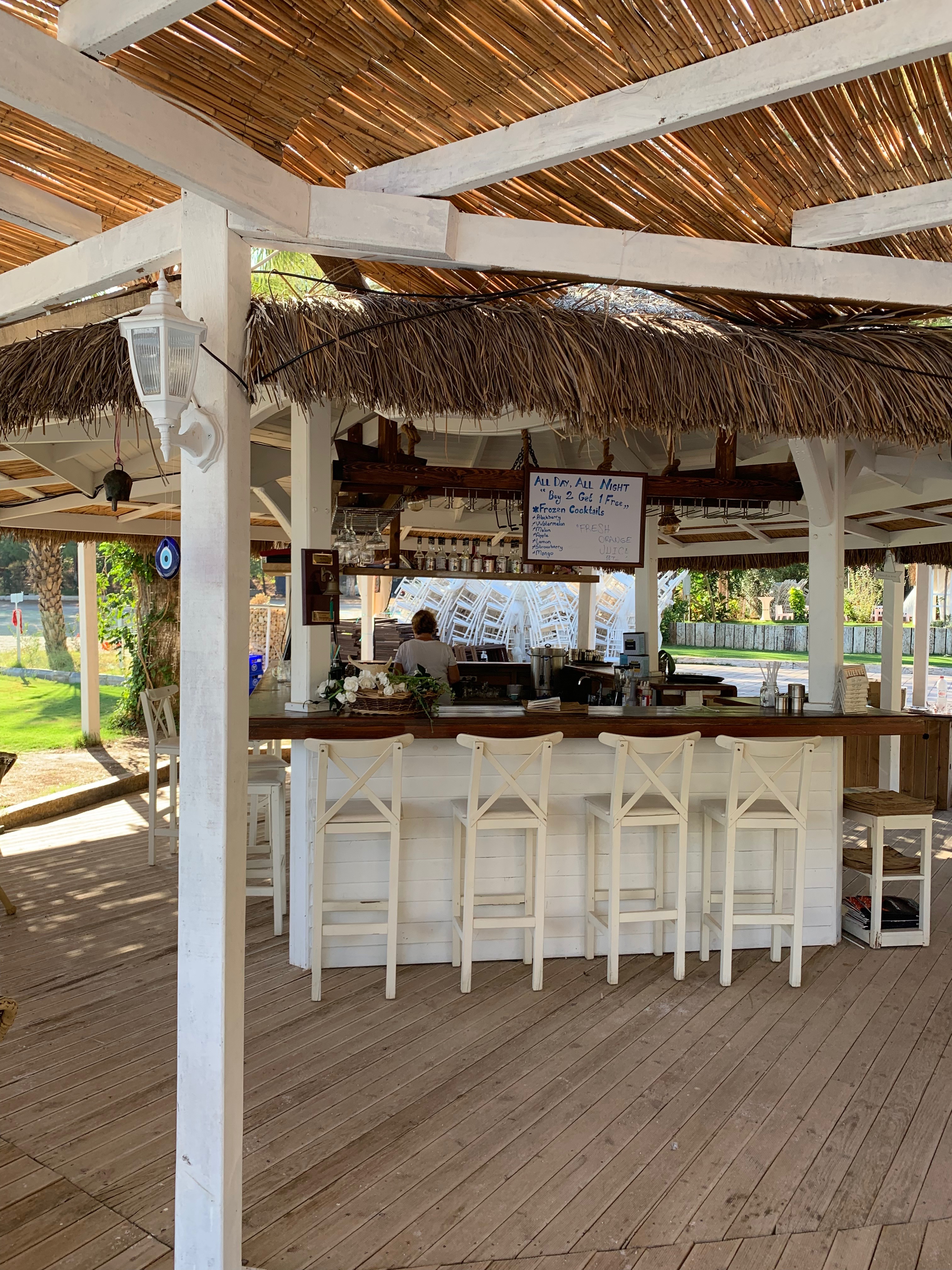
Beach bar at Fethiye
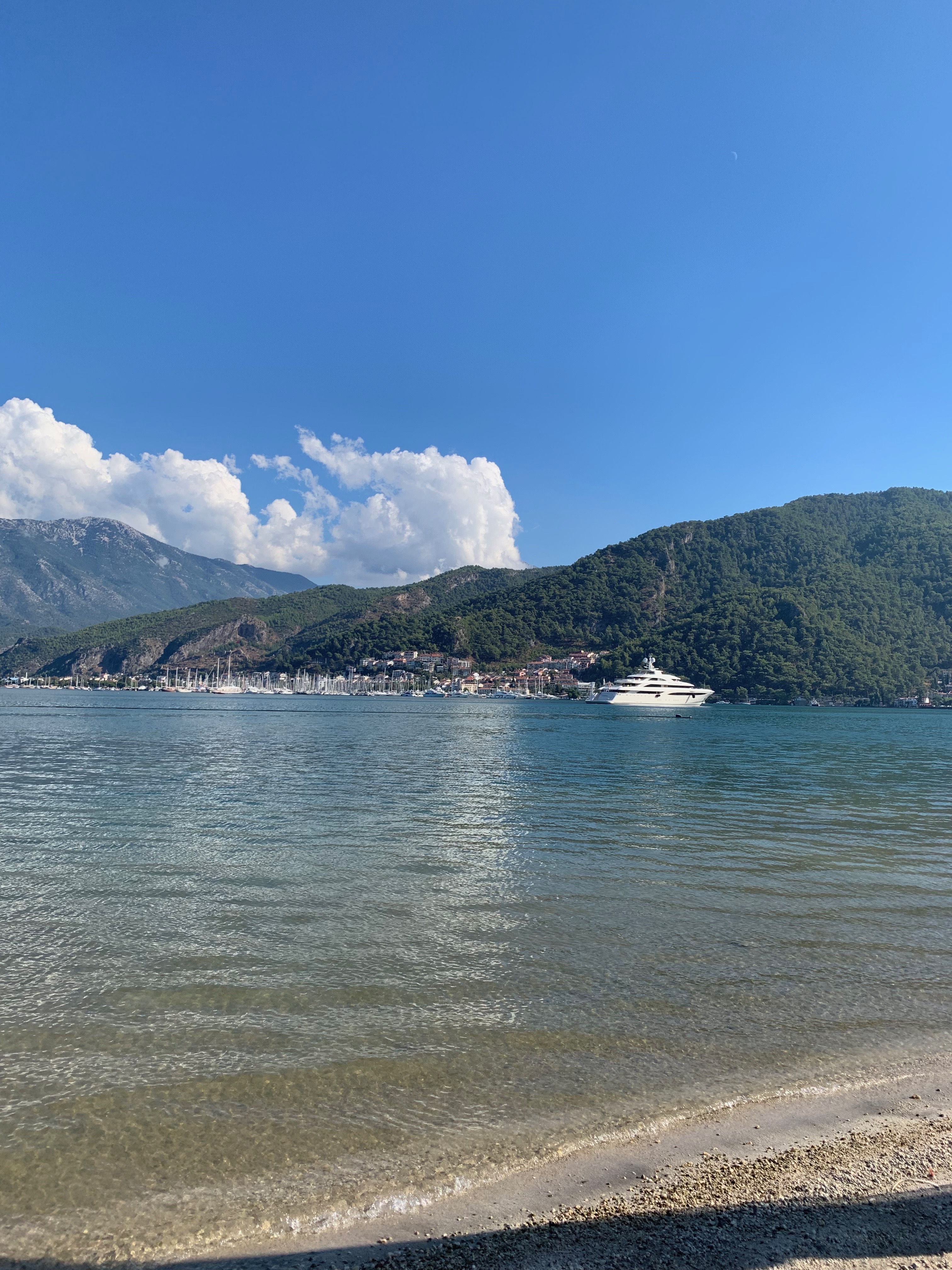
Harbor View to Fethiye
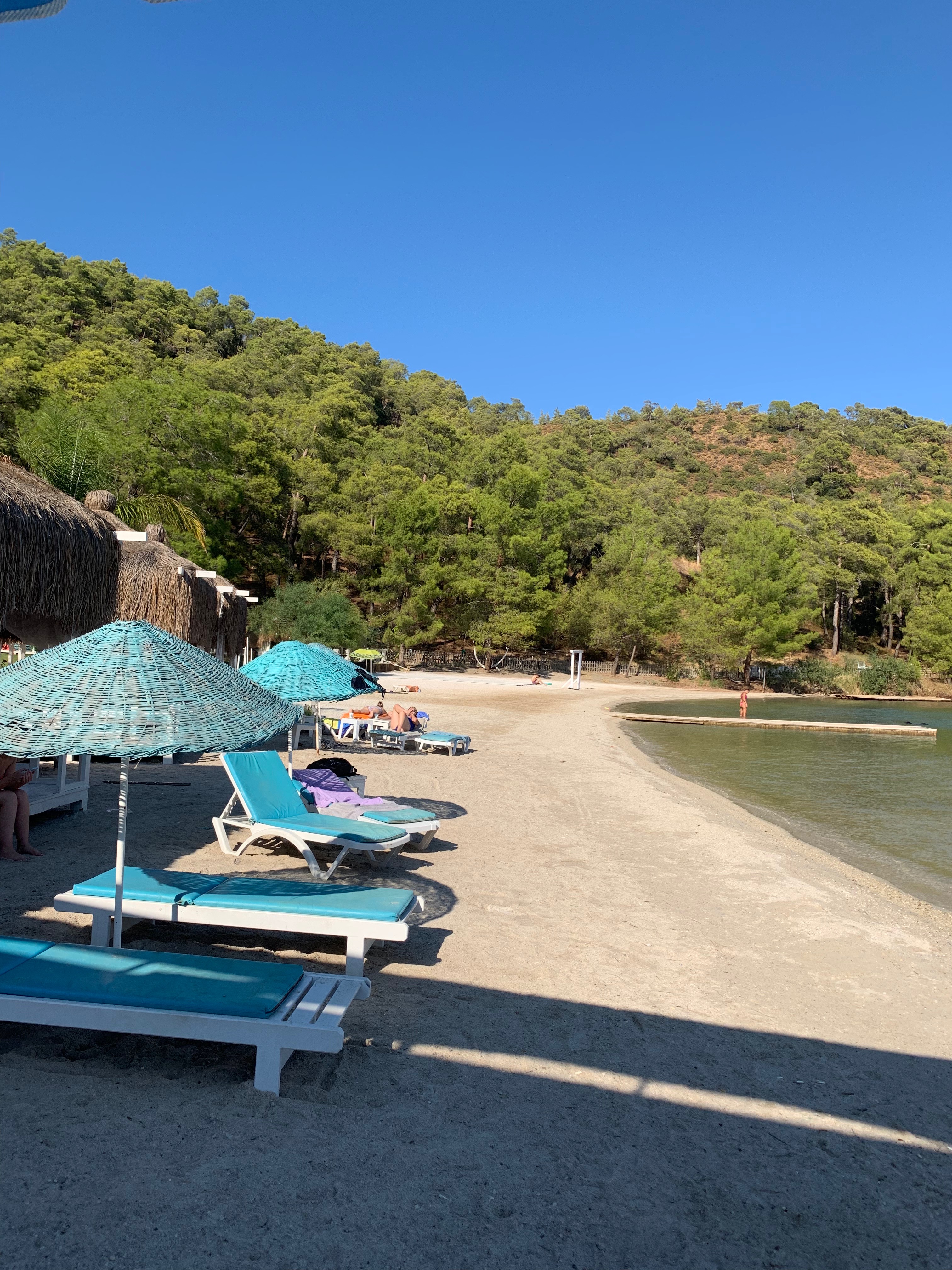
Beach at Fethiye. Turkey
Thursday October 3, 2019
ISPARTA, Turkey – Once in a while, we know we need to slow down and actually breathe. On Thursday, we tried to do just that, but still managed to run ourselves literally into the ground.
By the time we rolled into Isparta, within 30-minutes of the archaeological site of Kibyra, which we plan to visit on Friday, we felt the effects of 7-hours in the car and two pairs of legs reduced to rubber.
First, we left our hotel room in Marmaris and headed for the car. Across the street, Waynette spotted a convenience store and asked an older guy, minding the shop, if he had ice.
“Ice,” she said with animation. “Cold, ice?”
Yes, he nodded, and opened up a free-standing freezer which stored ice cream novelties. He lifted the rack of Magnums and other other treats and pulled out a bag of ice cubes.
He proceeded to hold up seven fingers and we ascertained the price was 7t, or seven Turkish lira. That’s about $1.25 in US.
Waynette, always the ice queen who made sure to pack an ice cube tray before we left Arizona, was in Arctic heaven.
The ice was packaged in a bag which cannot be obtained in any U.S. convenience store. Rather, this was packaged in a disposable ice cube tray and the cubes were the perfect size. We never purchased anything like that and Waynette didn’t stop talking about this for a while.
From Marmaris, we headed to Fethiye, site of a reported of some of the best beaches in Turkey. Turned out, the beaches were nearly non-existent. Then again, I’m not sure we looked in the right place. That’s because Waynette saw green lines and green coves on a map and we did find these precious expanses of sand.
We did find a small beach, but the area was overrun by school kids apparently on a school outing. We estimated more than 100 running around with little or no supervision. However, there was a stand. This was around 1 p.,m. and we left Marmaris without breakfast. We approached the snack bar and the guy said he was open for just one more hour.
“That’s fine,” we agreed, and ordered two chicken platters with chips (FF). (too many Brits visit here!) and salad. I went to the car, retrieved our water. The guy wiped off an outdoor table and seated Waynette.
Once I returned, we commented on these kids totally out of control and waited for our lunch. Twenty minutes passed, thirty, forty, one hour and the guy was nowhere in sight.
“Well, what do you want to do?” Waynette asked.
“Leave,” was my one word reply.
Without hesitation, we left, returned to the car and found, a few minutes later, a small beach with another outdoor beach bar. This time, the waitress was friendly and we ordered two chicken wraps with fries and a drink.
We finished and like all Europeans lingered for a some time, We checked the news on our phones and delivered texts to our kids. As we were leaving they were setting up a wedding for later that evening. This is now the third wedding that we saw held on the beach!
Around 4:30, we left and decided to drive to Isparta for the night. Waynette usually makes room reservations while on the road, and found a room in a new Hilton Garden Inn for $38. Great room and an even better bargain.
After checking in, we went to the room and made several other travel reservations. By this time, it was after 10 and a Chinese restaurant, located on the ground floor of the Hilton, was the closest restaurant. Quite to the point, I was not getting into the car any time soon and not for any reason!
Perfect, I said because I was tired of driving for the day. Overall, the drive from Fethiye to Isparta was four hours.
Generally, I’m surprised by the good road conditions in Turkey. The autobahns are usually four lanes and the roads are very driveable. That is, no potholes, and no rocks on the shoulder. What’s interesting to note is towns and communities appear nearly without notice right on the highway and it’s easy to pull on and off the highway. At one point, we pulled off the road at one of the many fruit and veggie stands, and Waynette bought a melon for snack time and a lime for her iced tea.
Turkey is quite mountainous and that adds to travel time. While distances on the map appear reasonable, the actual distance is challenging and what appears to be a two-hour drive can easily last twice that time or more.
For Friday, we plan to visit the sites in Kibyra and hope to arrive in Ankara, the national capital, by nightfall.
PICUTRES – Images from Fethiye

 markstravelblog2019